![[personal profile]](https://www.dreamwidth.org/img/silk/identity/user.png)


dylanmarron:
Cecil Baldwin talks openly about HIV for the first time. I love him, and I’m so incredibly proud of him. Honored to call him a friend, my fictional podcast boyfriend, and a stigma-ending badass.
from Tumblr http://ift.tt/2hTTJEN
via IFTTT

Cecil Baldwin talks openly about HIV for the first time. I love him, and I’m so incredibly proud of him. Honored to call him a friend, my fictional podcast boyfriend, and a stigma-ending badass.
from Tumblr http://ift.tt/2hTTJEN
via IFTTT
scullystorm:
“The gate to Limetown was left open. What the world discovered was the complete disappearance of every man, woman and child in Limetown. Three hundred and twenty seven people.”
from Tumblr http://ift.tt/2ieFt8k
via IFTTT

“The gate to Limetown was left open. What the world discovered was the complete disappearance of every man, woman and child in Limetown. Three hundred and twenty seven people.”
from Tumblr http://ift.tt/2ieFt8k
via IFTTT
writingwithcolor:
indi-flying-with-dragons:
janothar:
animatedamerican:
alternativetodiscourse:
animatedamerican:
bigsis144:
animatedamerican:
fenrisesque:
animatedamerican:
fenrisesque:
blood is not kosher
assuming vampires breathe, and are therefore alive, what do they do
If they’re alive and they need it to survive, it’s permitted (provided they don’t kill people in so doing).
If they’re not alive, halacha doesn’t apply to them.
Either way, there is no reasonable halachic restriction on a vampire drinking blood.
but would it need to be from a kosher animal
can they drink, like, dolphin blood
Okay now that gets interesting and I would want to actually ask a rabbi whether that would be a thing. like, if one must consume the blood of living things to survive, does it make a difference whether one limits it to the blood of kosher animals or not. I could see it being ruled either way. (I would think if there is only one type of blood one can metabolize or if only one type of blood is available, one can consume it regardless.)
I remember learning that human blood (not sure about animal blood) is permissible to consume if it has not been “poresh” (”separated”) from the body (in the context of “if you cut your lip or your finger and immediately and instinctively put it in your mouth, you don’t have to spit out the blood”).
So
Drinking blood out of a goblet or vacuum-sealed bag would be assur, but sinking your teeth into someone and drinking directly (so that the blood never touches the air or is in a vessel) would be okay.
I know that applies to one’s own blood, but I don’t know if the principle applies to someone else’s. But it may count as a possible precedent!
Okay, so I asked my rabbi about this (… yes, my actual rabbi). Short answer, @fenrisesque, is that the ideal situation is for the vampire to intravenously ingest blood that was donated by a human in order to stay alive, assuming that donation doesn’t kill the person. If homemade intravenously doesn’t work, then storebought oral ingestion is fine too. This applies whether or not the vampire can drink animal blood. Long answer, which I find fascinating but is long so under a cut:
Keep reading
THIS IS SO BEAUTIFUL please thank your rabbi for me
(also, consuming blood from a live person who will not be harmed by the loss of blood is completely different from killing and eating a person – because it is forbidden to derive material gain from a corpse, which includes using it for food, separately from any kosher/nonkosher issues.)
…ok, this is amazing. But also…Binyamin was a werewolf? I NEED TO KNOW WHICH COMMENTATOR THIS WAS and why they thought it. NEED.
And was he the first werewolf? Or were there werewolves prior? Is this the sort of werewolf who becomes one from a bite, or some other thing? DAMMIT RABBI, DON’T LEAVE ME HANGING!
Omg I never thought I’d read something like this.
Hey @writingwithcolor here’s something you can send your curious followers to if they wanna know if vampires drinking blood are actually against Jewish rules and beliefs or not.
Also here’s the link to them talking about Binyamin apparently being a werewolf that was discussed above: http://ift.tt/2haPmrH
Hey this is cool. Thanks!
from Tumblr http://ift.tt/2hpvDAA
via IFTTT

indi-flying-with-dragons:
janothar:
animatedamerican:
alternativetodiscourse:
animatedamerican:
bigsis144:
animatedamerican:
fenrisesque:
animatedamerican:
fenrisesque:
blood is not kosher
assuming vampires breathe, and are therefore alive, what do they do
If they’re alive and they need it to survive, it’s permitted (provided they don’t kill people in so doing).
If they’re not alive, halacha doesn’t apply to them.
Either way, there is no reasonable halachic restriction on a vampire drinking blood.
but would it need to be from a kosher animal
can they drink, like, dolphin blood
Okay now that gets interesting and I would want to actually ask a rabbi whether that would be a thing. like, if one must consume the blood of living things to survive, does it make a difference whether one limits it to the blood of kosher animals or not. I could see it being ruled either way. (I would think if there is only one type of blood one can metabolize or if only one type of blood is available, one can consume it regardless.)
I remember learning that human blood (not sure about animal blood) is permissible to consume if it has not been “poresh” (”separated”) from the body (in the context of “if you cut your lip or your finger and immediately and instinctively put it in your mouth, you don’t have to spit out the blood”).
So
Drinking blood out of a goblet or vacuum-sealed bag would be assur, but sinking your teeth into someone and drinking directly (so that the blood never touches the air or is in a vessel) would be okay.
I know that applies to one’s own blood, but I don’t know if the principle applies to someone else’s. But it may count as a possible precedent!
Okay, so I asked my rabbi about this (… yes, my actual rabbi). Short answer, @fenrisesque, is that the ideal situation is for the vampire to intravenously ingest blood that was donated by a human in order to stay alive, assuming that donation doesn’t kill the person. If homemade intravenously doesn’t work, then storebought oral ingestion is fine too. This applies whether or not the vampire can drink animal blood. Long answer, which I find fascinating but is long so under a cut:
Keep reading
THIS IS SO BEAUTIFUL please thank your rabbi for me
(also, consuming blood from a live person who will not be harmed by the loss of blood is completely different from killing and eating a person – because it is forbidden to derive material gain from a corpse, which includes using it for food, separately from any kosher/nonkosher issues.)
…ok, this is amazing. But also…Binyamin was a werewolf? I NEED TO KNOW WHICH COMMENTATOR THIS WAS and why they thought it. NEED.
And was he the first werewolf? Or were there werewolves prior? Is this the sort of werewolf who becomes one from a bite, or some other thing? DAMMIT RABBI, DON’T LEAVE ME HANGING!
Omg I never thought I’d read something like this.
Hey @writingwithcolor here’s something you can send your curious followers to if they wanna know if vampires drinking blood are actually against Jewish rules and beliefs or not.
Also here’s the link to them talking about Binyamin apparently being a werewolf that was discussed above: http://ift.tt/2haPmrH
Hey this is cool. Thanks!
from Tumblr http://ift.tt/2hpvDAA
via IFTTT
“
Why did the chicken cross the road?
Because the dead return. Because light reverses. Because the sky is a gap. Because it’s a shout. Because light reverses. Because the dead return. Because footsteps on the ceiling. Because footsteps in the basement. Because the sky is a shout. Because it’s a gap. Because the grass doesn’t grow, or grows too much, or grows wrong. Because the dead return. Because the dead return.
Because on one side was everything she had ever known, and on the other side was a future, maybe. And even though she was afraid to leave everything she had ever known, she also wanted a future, maybe. And so, hesitating, and then not, and then moving quickly, running, sprinting even, desperate, she crossed and found a future. Maybe. And left behind everything she had ever known.
Because when he woke up, he said, “No, I would never cross that road.” He ate beans for breakfast and started at those who crossed. And, when noon came around, he said “I would never cross that road.” He ate leaves for lunch and laughed at those who crossed. And when the evening came, he asked one of the crossers, “Say, what’s so good about the other side?” And the crosser waved him away and said, “What do you care? Someone like you would never cross this road.” And that made him angry, so he crossed the road out of spite. The other side was okay. He ate beans for dinner.
Because the dead are born. Because the dead grow and eat. Because the dead make bad decisions, and good decisions. Because the dead sit at tables, or on the floor, talking about food and decisions they’ve made. Because the dead love. Because they love, that’s why. But also, because the dead work, and make things for the rest of the dead, and then the dead slow, and relax, and lean back onto the time that’s given to them. And when there is no time left for them to lean on, they fall, and the dead finally die.
Because she looked one day, and there was a structure there. Imagine a spire. No, higher than that. It had crystalline windows, and crystalline walls. It swayed in the wind, the wind sang against it. Imagine a spire. No, higher than that. She was crying before she knew it. Before she knew it, she had one hand over her mouth and one foot in the road. She was standing in its doorway. She had already crossed the road before she had known it. The tower went up, and up, and up. She went into it and went up, and up, and up. Imagine a spire. No, higher than that.
Because when the stars call, you answer. Even if you don’t know if they really called you. Even if you don’t believe that they can call anyone. Even if, maybe, you were just outside, like normal, just looking up at the sky normally, and the stars were as they always are, but you weren’t as you always are. Because the stars didn’t change, you did. And once you were different, you couldn’t live like you were the same. You had to live differently. You had to. You had to.
Because time moves so slowly, doesn’t it? Only sometimes it moves so fast. Some days the morning is done by nine, some afternoons linger long after sunset. “What time is it?” you’ll ask. “What time is it?” you’ll ask over and over for years, a repetition of thousands throughout your life. What time is it? What time is it? Time moves so slowly, doesn’t it? Only sometimes it moves so fast. But it was only just morning! But I only just had lunch! Is it evening already? When will the morning come again? When will the morning come again? It’s been so dark. So dark, for so long. When will the morning come again? Time moves so slowly, doesn’t it? Only sometimes it moves so fast.
Because she took each day as it came. Taken with many things, but never taking any of them. She never took any risks. Instead, she took care. She never took any opportunities, she took the safe way instead. Because she didn’t take it, you know? Grasp it, pull it toward her. Instead she just took it, you know? Let it happen, let it slip by. Until she stopped taking it. Wouldn’t take it for another second. Instead, she took it, you know? The next step, the necessary arrangements, her life in her hands. She took her life in her hands. She took it. She was taking, and not taken. And she saw a road to cross, and she was taken by it. And she took it. She took it.
Because there is power in movement. Not any particular movement, not dance (although also dance), not athletics (although also athletics), but movement. Just the absence of stillness. Just anything that takes a person from one spot to the next. And if there is a why, then so be it, but it is inconsequential to the fact of it. The fact of air in the lungs. The fact of feet, and a road. The implications of a road, and what it means to not go down that road or back the way you came, but perpendicular. To cross it. To make that move. Because the secret is, it was not to get to the other side, or to any other place. Places are beside the point. But just for the power of crossing. Of movement.
Why did the chicken cross the road? To get to the other side.
Sometimes, that’s all it is.
”
- Alice Isn’t Dead
from Tumblr http://ift.tt/2hXqIrs
via IFTTT

Why did the chicken cross the road?
Because the dead return. Because light reverses. Because the sky is a gap. Because it’s a shout. Because light reverses. Because the dead return. Because footsteps on the ceiling. Because footsteps in the basement. Because the sky is a shout. Because it’s a gap. Because the grass doesn’t grow, or grows too much, or grows wrong. Because the dead return. Because the dead return.
Because on one side was everything she had ever known, and on the other side was a future, maybe. And even though she was afraid to leave everything she had ever known, she also wanted a future, maybe. And so, hesitating, and then not, and then moving quickly, running, sprinting even, desperate, she crossed and found a future. Maybe. And left behind everything she had ever known.
Because when he woke up, he said, “No, I would never cross that road.” He ate beans for breakfast and started at those who crossed. And, when noon came around, he said “I would never cross that road.” He ate leaves for lunch and laughed at those who crossed. And when the evening came, he asked one of the crossers, “Say, what’s so good about the other side?” And the crosser waved him away and said, “What do you care? Someone like you would never cross this road.” And that made him angry, so he crossed the road out of spite. The other side was okay. He ate beans for dinner.
Because the dead are born. Because the dead grow and eat. Because the dead make bad decisions, and good decisions. Because the dead sit at tables, or on the floor, talking about food and decisions they’ve made. Because the dead love. Because they love, that’s why. But also, because the dead work, and make things for the rest of the dead, and then the dead slow, and relax, and lean back onto the time that’s given to them. And when there is no time left for them to lean on, they fall, and the dead finally die.
Because she looked one day, and there was a structure there. Imagine a spire. No, higher than that. It had crystalline windows, and crystalline walls. It swayed in the wind, the wind sang against it. Imagine a spire. No, higher than that. She was crying before she knew it. Before she knew it, she had one hand over her mouth and one foot in the road. She was standing in its doorway. She had already crossed the road before she had known it. The tower went up, and up, and up. She went into it and went up, and up, and up. Imagine a spire. No, higher than that.
Because when the stars call, you answer. Even if you don’t know if they really called you. Even if you don’t believe that they can call anyone. Even if, maybe, you were just outside, like normal, just looking up at the sky normally, and the stars were as they always are, but you weren’t as you always are. Because the stars didn’t change, you did. And once you were different, you couldn’t live like you were the same. You had to live differently. You had to. You had to.
Because time moves so slowly, doesn’t it? Only sometimes it moves so fast. Some days the morning is done by nine, some afternoons linger long after sunset. “What time is it?” you’ll ask. “What time is it?” you’ll ask over and over for years, a repetition of thousands throughout your life. What time is it? What time is it? Time moves so slowly, doesn’t it? Only sometimes it moves so fast. But it was only just morning! But I only just had lunch! Is it evening already? When will the morning come again? When will the morning come again? It’s been so dark. So dark, for so long. When will the morning come again? Time moves so slowly, doesn’t it? Only sometimes it moves so fast.
Because she took each day as it came. Taken with many things, but never taking any of them. She never took any risks. Instead, she took care. She never took any opportunities, she took the safe way instead. Because she didn’t take it, you know? Grasp it, pull it toward her. Instead she just took it, you know? Let it happen, let it slip by. Until she stopped taking it. Wouldn’t take it for another second. Instead, she took it, you know? The next step, the necessary arrangements, her life in her hands. She took her life in her hands. She took it. She was taking, and not taken. And she saw a road to cross, and she was taken by it. And she took it. She took it.
Because there is power in movement. Not any particular movement, not dance (although also dance), not athletics (although also athletics), but movement. Just the absence of stillness. Just anything that takes a person from one spot to the next. And if there is a why, then so be it, but it is inconsequential to the fact of it. The fact of air in the lungs. The fact of feet, and a road. The implications of a road, and what it means to not go down that road or back the way you came, but perpendicular. To cross it. To make that move. Because the secret is, it was not to get to the other side, or to any other place. Places are beside the point. But just for the power of crossing. Of movement.
Why did the chicken cross the road? To get to the other side.
Sometimes, that’s all it is.
”
- Alice Isn’t Dead
from Tumblr http://ift.tt/2hXqIrs
via IFTTT
remembertowrite:
azraeldigabriel:
buckybabs:
Someone is disappointed that the sever keeps locking them out 😭😝😍
I bet Richards favourite type is Ghost.
Wait, Dr. Strand, is that a–
OH MY GOD, are you okay?
WHAT DO YOU MEAN GHOSTS AREN’T REAL THERE’S ONE EATING YOUR DREAMS RIGHT NOW
from Tumblr http://ift.tt/2hQ6Iam
via IFTTT

azraeldigabriel:
buckybabs:
Someone is disappointed that the sever keeps locking them out 😭😝😍
I bet Richards favourite type is Ghost.
Wait, Dr. Strand, is that a–
OH MY GOD, are you okay?
WHAT DO YOU MEAN GHOSTS AREN’T REAL THERE’S ONE EATING YOUR DREAMS RIGHT NOW
from Tumblr http://ift.tt/2hQ6Iam
via IFTTT

gunpowderandspark:
thisiseverydayracism:
micdotcom:
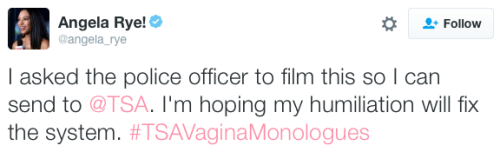
CNN commentator Angela Rye shares “humiliating” TSA experience on Twitter
On Thursday, Angela Rye shared a video of her experience being “randomly selected” for a full-body search at Detroit Metropolitan Airport by the TSA.
The video — which Rye says she asked a police officer to film — shows a TSA agent patting down Rye’s hair, shoulders, arms, back and torso.
The agent then moves toward her genitals, at which point the agent lifts up the hem of Rye’s dress to search her upper thighs and crotch.
In a phone interview Friday, Rye said even after clearing two security scanners — “I didn’t beep,” she clarified in a later tweet — she was still selected for random screening when the scanner lit up around her crotch.
A glance at the #TSAVaginaMonologues hashtag reveals Rye’s experience is far from a rare occurrence.
Multiple women attested to triggering body-scan sensors and being subjected to similar searches. Read more
This is fucking sexual assault.
Here’s the insult to the injury: It’s been proven that the TSA doesn’t prevent any attacks. It’s been well documented that the only effect they have is that they make people feel safer without actually contributing to that safety. Their entire job is to make us feel better about flying.
And they use that power to sexually assault us.
from Tumblr http://ift.tt/2gVOZMJ
via IFTTT
thisiseverydayracism:
micdotcom:
CNN commentator Angela Rye shares “humiliating” TSA experience on Twitter
On Thursday, Angela Rye shared a video of her experience being “randomly selected” for a full-body search at Detroit Metropolitan Airport by the TSA.
The video — which Rye says she asked a police officer to film — shows a TSA agent patting down Rye’s hair, shoulders, arms, back and torso.
The agent then moves toward her genitals, at which point the agent lifts up the hem of Rye’s dress to search her upper thighs and crotch.
In a phone interview Friday, Rye said even after clearing two security scanners — “I didn’t beep,” she clarified in a later tweet — she was still selected for random screening when the scanner lit up around her crotch.
A glance at the #TSAVaginaMonologues hashtag reveals Rye’s experience is far from a rare occurrence.
Multiple women attested to triggering body-scan sensors and being subjected to similar searches. Read more
This is fucking sexual assault.
Here’s the insult to the injury: It’s been proven that the TSA doesn’t prevent any attacks. It’s been well documented that the only effect they have is that they make people feel safer without actually contributing to that safety. Their entire job is to make us feel better about flying.
And they use that power to sexually assault us.
from Tumblr http://ift.tt/2gVOZMJ
via IFTTT
A generation of artists were wiped out by Aids and we barely talk about it:
simperingcreatures:
“Yet there was a time when you could walk around London or New York and see these gaunt faces, marked with sarcomas, and everyone you hung out with was dying. The official culture was in denial. Sometimes it was easier to be. I remember seeing Derek Jarman at a play. At that point he was blind. I didn’t want to see him like that. And then my friend was queer-bashed on the way home. Freddie Mercury died. Keith Haring died. Eazy- E from NWA died. Denholm Elliott died. Rock Hudson died. Fela Kuti died. And my uncle who wasn’t famous or even my actual uncle died. One of my friends lost seven people who were all under 30.”
from Tumblr http://ift.tt/2gVP0Ah
via IFTTT

simperingcreatures:
“Yet there was a time when you could walk around London or New York and see these gaunt faces, marked with sarcomas, and everyone you hung out with was dying. The official culture was in denial. Sometimes it was easier to be. I remember seeing Derek Jarman at a play. At that point he was blind. I didn’t want to see him like that. And then my friend was queer-bashed on the way home. Freddie Mercury died. Keith Haring died. Eazy- E from NWA died. Denholm Elliott died. Rock Hudson died. Fela Kuti died. And my uncle who wasn’t famous or even my actual uncle died. One of my friends lost seven people who were all under 30.”
from Tumblr http://ift.tt/2gVP0Ah
via IFTTT
radical-rin:
K so here’s a Tiny Strand on a blank background if you wanna try and photoshop him/print him out and hang him up in a church somewhere to piss him off. This is a photo and not a scanned version (sorry my technology is difficult and refusing to work) so I’m going to apologize ahead of time if it’s all shitty and blurry and pixelated.
Also my original Tiny Strand is 5 inches tall and 1 ½ inches wide if you want that for reference but hey it’s your thing make him as big or as tiny as you want I don’t give a fuck
from Tumblr http://ift.tt/2hN9MEb
via IFTTT

K so here’s a Tiny Strand on a blank background if you wanna try and photoshop him/print him out and hang him up in a church somewhere to piss him off. This is a photo and not a scanned version (sorry my technology is difficult and refusing to work) so I’m going to apologize ahead of time if it’s all shitty and blurry and pixelated.
Also my original Tiny Strand is 5 inches tall and 1 ½ inches wide if you want that for reference but hey it’s your thing make him as big or as tiny as you want I don’t give a fuck
from Tumblr http://ift.tt/2hN9MEb
via IFTTT
nightvalecommunityfanon:
The Narrator from Alice Isn’t Dead is Cecil’s long-lost older sister.
from Tumblr http://ift.tt/2hRNKQl
via IFTTT
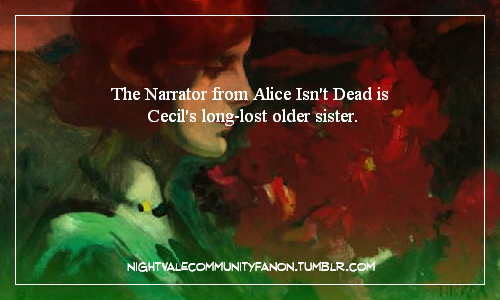
The Narrator from Alice Isn’t Dead is Cecil’s long-lost older sister.
from Tumblr http://ift.tt/2hRNKQl
via IFTTT
dunnetwins: “Of course, don’t be an
Dec. 19th, 2016 11:02 amdunnetwins:
“Of course, don’t be an idiot. You’re my scarecrow.” “Why the hell’s that?” “Because I’ll miss you most of all.” // “I’m going to change the world, and I can’t do that without you. We’re going to Oz, and I need my Dorothy.”
goodbye, dorothy | a mix for max finlayson and deidre wells
from Tumblr http://ift.tt/2h1t75Y
via IFTTT
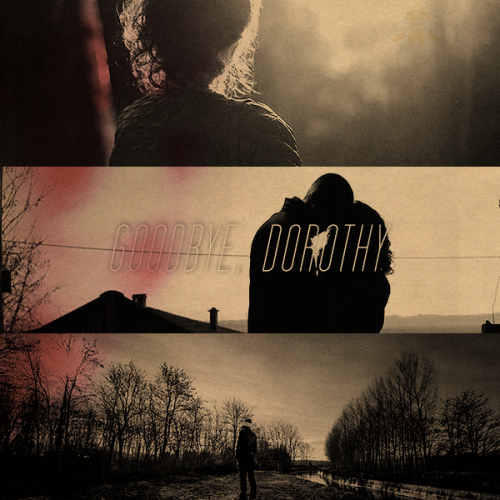
“Of course, don’t be an idiot. You’re my scarecrow.” “Why the hell’s that?” “Because I’ll miss you most of all.” // “I’m going to change the world, and I can’t do that without you. We’re going to Oz, and I need my Dorothy.”
goodbye, dorothy | a mix for max finlayson and deidre wells
from Tumblr http://ift.tt/2h1t75Y
via IFTTT
risarodil:
Turned some of my favorite @linmanuel tweets into art — even though his words are already art on their own. Here’s the complete set!
from Tumblr http://ift.tt/2hP3WBX
via IFTTT

Turned some of my favorite @linmanuel tweets into art — even though his words are already art on their own. Here’s the complete set!
from Tumblr http://ift.tt/2hP3WBX
via IFTTT
wtfzeus:
caecilius-est-pater:
sarahruhlofficial:
the oompa loompas are a greek chorus
First of all, I hate this so much. Second of all, imagine if the two switched places.
(Veruca falls into the trash chute)
Chorus: Pray thou no more; for mortals have no escape from destined woe. Wisdom is the supreme part of happiness; and reverence towards the gods must be inviolate. Great words of prideful men are ever punished with great blows…
(Oedipus stabs his eyes out)
Oompa Loompas: Oompa loompa doopity do
I’ve got another riddle for you
What do you get when you sleep with your mum?
A curse on your kids for decades to come~
Again, very little to do with Zeus but fuck this shit is hilarious
from Tumblr http://ift.tt/2hJTHl2
via IFTTT

caecilius-est-pater:
sarahruhlofficial:
the oompa loompas are a greek chorus
First of all, I hate this so much. Second of all, imagine if the two switched places.
(Veruca falls into the trash chute)
Chorus: Pray thou no more; for mortals have no escape from destined woe. Wisdom is the supreme part of happiness; and reverence towards the gods must be inviolate. Great words of prideful men are ever punished with great blows…
(Oedipus stabs his eyes out)
Oompa Loompas: Oompa loompa doopity do
I’ve got another riddle for you
What do you get when you sleep with your mum?
A curse on your kids for decades to come~
Again, very little to do with Zeus but fuck this shit is hilarious
from Tumblr http://ift.tt/2hJTHl2
via IFTTT
goodnightmybilly:
The greatest accomplishment of Rogue One to me is the fact that it will forever change the way people will view the events of Episode 4, 5, and 6. And it will change it for the better.
What happens in Rogue One gives so much meaning to what happens in the original trilogy. Suddenly now the Rebellion is given the depth and complexity it never had. Vader and Tarkin are even more terrifying and sinister. And more than anything else, the destruction of the first Death Star and the eventual victory of the Rebellion in bringing about the fall of the Empire carries even more weight and becomes all the more satisfying because we saw the sacrifice it took for all of this to come to pass. The celebration on Endor will never be the same, because that happiness only exists because of Rogue One.
The original trilogy happened because one group of rebels took it upon themselves to not give up when everyone else did, and in doing so, gave the Rebellion the kick it needed to bring freedom to the galaxy.
Without Rogue One, there wouldn’t have been the original trilogy.
They had a new hope because Rogue One gave it to them.
from Tumblr http://ift.tt/2hWRuDl
via IFTTT

The greatest accomplishment of Rogue One to me is the fact that it will forever change the way people will view the events of Episode 4, 5, and 6. And it will change it for the better.
What happens in Rogue One gives so much meaning to what happens in the original trilogy. Suddenly now the Rebellion is given the depth and complexity it never had. Vader and Tarkin are even more terrifying and sinister. And more than anything else, the destruction of the first Death Star and the eventual victory of the Rebellion in bringing about the fall of the Empire carries even more weight and becomes all the more satisfying because we saw the sacrifice it took for all of this to come to pass. The celebration on Endor will never be the same, because that happiness only exists because of Rogue One.
The original trilogy happened because one group of rebels took it upon themselves to not give up when everyone else did, and in doing so, gave the Rebellion the kick it needed to bring freedom to the galaxy.
Without Rogue One, there wouldn’t have been the original trilogy.
They had a new hope because Rogue One gave it to them.
from Tumblr http://ift.tt/2hWRuDl
via IFTTT
thebibliosphere:
penfairy:
zetsubouloli:
penfairy:
Women have more power and agency in Shakespeare’s comedies than in his tragedies, and usually there are more of them with more speaking time, so I’m pretty sure what Shakespeare’s saying is “men ruin everything” because everyone fucking dies when men are in charge but when women are in charge you get married and live happily ever after
I think you’re reading too far into things, kiddo.
Take a break from your women’s studies major and get some fresh air.
Right. Well, I’m a historian, so allow me to elaborate.
One of the most important aspects of the Puritan/Protestant revolution (in the 1590’s in particular) was the foregrounding of marriage as the most appropriate way of life. It often comes as a surprise when people learn this, but Puritans took an absolutely positive view of sexuality within the context of marriage. Clergy were encouraged to lead by example and marry and have children, as opposed to Catholic clergy who prized virginity above all else. Through his comedies, Shakespeare was promoting this new way of life which had never been promoted before. The dogma, thanks to the church, had always been “durr hburr women are evil sex is bad celibacy is your ticket to salvation.” All that changed in Shakespeare’s time, and thanks to him we get a view of the world where marriage, women, and sexuality are in fact the key to salvation.
The difference between the structure of a comedy and a tragedy is that the former is cyclical, and the latter a downward curve. Comedies weren’t stupid fun about the lighter side of life. The definition of a comedy was not a funny play. They were plays that began in turmoil and ended in reconciliation and renewal. They showed the audience the path to salvation, with the comic ending of a happy marriage leaving the promise of societal regeneration intact. Meanwhile, in the tragedies, there is no such promise of regeneration or salvation. The characters destroy themselves. The world in which they live is not sustainable. It leads to a dead end, with no promise of new life.
And so, in comedies, the women are the movers and shakers. They get things done. They move the machinery of the plot along. In tragedies, though women have an important part to play, they are often morally bankrupt as compared to the women of comedies, or if they are morally sound, they are disenfranchised and ignored, and refused the chance to contribute to the society in which they live. Let’s look at some examples.
In Romeo and Juliet, the play ends in tragedy because no-one listens to Juliet. Her father and Paris both insist they know what’s right for her, and they refuse to listen to her pleas for clemency. Juliet begs them – screams, cries, manipulates, tells them outright I cannot marry, just wait a week before you make me marry Paris, just a week, please and they ignore her, and force her into increasingly desperate straits, until at last the two young lovers kill themselves. The message? This violent, hate-filled patriarchal world is unsustainable. The promise of regeneration is cut down with the deaths of these children. Compare to Othello. This is the most horrifying and intimate tragedy of all, with the climax taking place in a bedroom as a husband smothers his young wife. The tragedy here could easily have been averted if Othello had listened to Desdemona and Emilia instead of Iago. The message? This society, built on racism and misogyny and martial, masculine honour, is unsustainable, and cannot regenerate itself. The very horror of it lies in the murder of two wives.
How about Hamlet? Ophelia is a disempowered character, but if Hamlet had listened to her, and not mistreated her, and if her father hadn’t controlled every aspect of her life, then perhaps she wouldn’t have committed suicide. The final scene of carnage is prompted by Laertes and Hamlet furiously grappling over her corpse. When Ophelia dies, any chance of reconciliation dies with her. The world collapses in on itself. This society is unsustainable. King Lear – we all know that this is prompted by Cordelia’s silence, her unwillingness to bend the knee and flatter in the face of tyranny. It is Lear’s disproportionate response to this that sets off the tragedy, and we get a play that is about entropy, aging and the destruction of the social order.
There are exceptions to the rule. I’m sure a lot of you are crying out “but Lady Macbeth!” and it’s a good point. However, in terms of raw power, neither Lady Macbeth nor the witches are as powerful as they appear. The only power they possess is the ability to influence Macbeth; but ultimately it is Macbeth’s own ambition that prompts him to murder Duncan, and it is he who escalates the situation while Lady Macbeth suffers a breakdown. In this case you have women who are allowed to influence the play, but do so for the worse; they fail to be the good moral compasses needed. Goneril, Regan and Gertrude are similarly comparable; they possess a measure of power, but do not use it for good, and again society cannot renew itself.
Now we come to the comedies, where women do have the most control over the plot. The most powerful example is Rosalind in As You Like It. She pulls the strings in every avenue of the plot, and it is thanks to her control that reconciliation is achieved at the end, and all end up happily married. Much Ado About Nothing pivots around a woman’s anger over the abuse of her innocent cousin. If the men were left in charge in this play, no-one would be married at the end, and it would certainly end in tragedy. But Beatrice stands up and rails against men for their cruel conduct towards women and says that famous, spine-tingling line - oh God, that I were a man! I would eat his heart in the marketplace. And Benedick, her suitor, listens to her. He realises that his misogynistic view of the world is wrong and he takes steps to change it. He challenges his male friends for their conduct, parts company with the prince, and by doing this he wins his lady’s hand. The entire happy ending is dependent on the men realising that they must trust, love and respect women. Now it is a society that is worthy of being perpetuated. Regeneration and salvation lies in equality between the sexes and the love husbands and wives cherish for each other. The Merry Wives of Windsor - here we have men learning to trust and respect their wives, Flastaff learning his lesson for trying to seduce married women, and a daughter tricking everyone so she can marry the man she truly loves. A Midsummer Night’s Dream? The turmoil begins because three men are trying to force Hermia to marry someone she does not love, and Helena has been cruelly mistreated. At the end, happiness and harmony comes when the women are allowed to marry the men of their choosing, and it is these marriages that are blessed by the fairies.
What of the romances? In The Tempest, Prospero holds the power, but it is Miranda who is the key to salvation and a happy ending. Without his daughter, it is likely Prospero would have turned into a murderous revenger. The Winter’s Tale sees Leontes destroy himself through his own jealousy. The king becomes a vicious tyrant because he is cruel to his own wife and children, and this breach of faith in suspecting his wife of adultery almost brings ruin to his entire kingdom. Only by obeying the sensible Emilia does Leontes have a chance of achieving redemption, and the pure trust and love that exists between Perdita and Florizel redeems the mistakes of the old generation and leads to a happy ending. Cymbeline? Imogen is wronged, and it is through her love and forgiveness that redemption is achieved at the end. In all of these plays, without the influence of the women there is no happy ending.
The message is clear. Without a woman’s consent and co-operation in living together and bringing up a family, there is turmoil. Equality between the sexes and trust between husbands and wives alone will bring happiness and harmony, not only to the family unit, but to society as a whole. The Taming of the Shrew rears its ugly head as a counter-example, for here a happy ending is dependent on a woman’s absolute subservience and obedience even in the face of abuse. But this is one of Shakespeare’s early plays (and a rip-off of an older comedy called The Taming of a Shrew) and it is interesting to look at how the reception of this play changed as values evolved in this society.
As early as 1611 The Shrew was adapted by the writer John Fletcher in a play called The Woman’s Prize, or The Tamer Tamed. It is both a sequel and an imitation, and it chronicles Petruchio’s search for a second wife after his disastrous marriage with Katherine (whose taming had been temporary) ended with her death. In Fletcher’s version, the men are outfoxed by the women and Petruchio is ‘tamed’ by his new wife. It ends with a rather uplifting epilogue that claims the play aimed:
To teach both sexes due equality
And as they stand bound, to love mutually.
The Taming of the Shrew and The Tamer Tamed were staged back to back in 1633, and it was recorded that although Shakespeare’s Shrew was “liked”, Fletcher’s Tamer Tamed was “very well liked.” You heard it here folks; as early as 1633 audiences found Shakespeare’s message of total female submission uncomfortable, and they preferred John Fletcher’s interpretation and his message of equality between the sexes.
So yes. The message we can take away from Shakespeare is that a world in which women are powerless and cannot or do not contribute positively to society and family is unsustainable. Men, given the power and left to their own devices, will destroy themselves. But if men and women can work together and live in harmony, then the whole community has a chance at salvation, renewal and happiness.
In the immortal words of the bard himself: fucking annihilated.
from Tumblr http://ift.tt/2gPGkLA
via IFTTT

penfairy:
zetsubouloli:
penfairy:
Women have more power and agency in Shakespeare’s comedies than in his tragedies, and usually there are more of them with more speaking time, so I’m pretty sure what Shakespeare’s saying is “men ruin everything” because everyone fucking dies when men are in charge but when women are in charge you get married and live happily ever after
I think you’re reading too far into things, kiddo.
Take a break from your women’s studies major and get some fresh air.
Right. Well, I’m a historian, so allow me to elaborate.
One of the most important aspects of the Puritan/Protestant revolution (in the 1590’s in particular) was the foregrounding of marriage as the most appropriate way of life. It often comes as a surprise when people learn this, but Puritans took an absolutely positive view of sexuality within the context of marriage. Clergy were encouraged to lead by example and marry and have children, as opposed to Catholic clergy who prized virginity above all else. Through his comedies, Shakespeare was promoting this new way of life which had never been promoted before. The dogma, thanks to the church, had always been “durr hburr women are evil sex is bad celibacy is your ticket to salvation.” All that changed in Shakespeare’s time, and thanks to him we get a view of the world where marriage, women, and sexuality are in fact the key to salvation.
The difference between the structure of a comedy and a tragedy is that the former is cyclical, and the latter a downward curve. Comedies weren’t stupid fun about the lighter side of life. The definition of a comedy was not a funny play. They were plays that began in turmoil and ended in reconciliation and renewal. They showed the audience the path to salvation, with the comic ending of a happy marriage leaving the promise of societal regeneration intact. Meanwhile, in the tragedies, there is no such promise of regeneration or salvation. The characters destroy themselves. The world in which they live is not sustainable. It leads to a dead end, with no promise of new life.
And so, in comedies, the women are the movers and shakers. They get things done. They move the machinery of the plot along. In tragedies, though women have an important part to play, they are often morally bankrupt as compared to the women of comedies, or if they are morally sound, they are disenfranchised and ignored, and refused the chance to contribute to the society in which they live. Let’s look at some examples.
In Romeo and Juliet, the play ends in tragedy because no-one listens to Juliet. Her father and Paris both insist they know what’s right for her, and they refuse to listen to her pleas for clemency. Juliet begs them – screams, cries, manipulates, tells them outright I cannot marry, just wait a week before you make me marry Paris, just a week, please and they ignore her, and force her into increasingly desperate straits, until at last the two young lovers kill themselves. The message? This violent, hate-filled patriarchal world is unsustainable. The promise of regeneration is cut down with the deaths of these children. Compare to Othello. This is the most horrifying and intimate tragedy of all, with the climax taking place in a bedroom as a husband smothers his young wife. The tragedy here could easily have been averted if Othello had listened to Desdemona and Emilia instead of Iago. The message? This society, built on racism and misogyny and martial, masculine honour, is unsustainable, and cannot regenerate itself. The very horror of it lies in the murder of two wives.
How about Hamlet? Ophelia is a disempowered character, but if Hamlet had listened to her, and not mistreated her, and if her father hadn’t controlled every aspect of her life, then perhaps she wouldn’t have committed suicide. The final scene of carnage is prompted by Laertes and Hamlet furiously grappling over her corpse. When Ophelia dies, any chance of reconciliation dies with her. The world collapses in on itself. This society is unsustainable. King Lear – we all know that this is prompted by Cordelia’s silence, her unwillingness to bend the knee and flatter in the face of tyranny. It is Lear’s disproportionate response to this that sets off the tragedy, and we get a play that is about entropy, aging and the destruction of the social order.
There are exceptions to the rule. I’m sure a lot of you are crying out “but Lady Macbeth!” and it’s a good point. However, in terms of raw power, neither Lady Macbeth nor the witches are as powerful as they appear. The only power they possess is the ability to influence Macbeth; but ultimately it is Macbeth’s own ambition that prompts him to murder Duncan, and it is he who escalates the situation while Lady Macbeth suffers a breakdown. In this case you have women who are allowed to influence the play, but do so for the worse; they fail to be the good moral compasses needed. Goneril, Regan and Gertrude are similarly comparable; they possess a measure of power, but do not use it for good, and again society cannot renew itself.
Now we come to the comedies, where women do have the most control over the plot. The most powerful example is Rosalind in As You Like It. She pulls the strings in every avenue of the plot, and it is thanks to her control that reconciliation is achieved at the end, and all end up happily married. Much Ado About Nothing pivots around a woman’s anger over the abuse of her innocent cousin. If the men were left in charge in this play, no-one would be married at the end, and it would certainly end in tragedy. But Beatrice stands up and rails against men for their cruel conduct towards women and says that famous, spine-tingling line - oh God, that I were a man! I would eat his heart in the marketplace. And Benedick, her suitor, listens to her. He realises that his misogynistic view of the world is wrong and he takes steps to change it. He challenges his male friends for their conduct, parts company with the prince, and by doing this he wins his lady’s hand. The entire happy ending is dependent on the men realising that they must trust, love and respect women. Now it is a society that is worthy of being perpetuated. Regeneration and salvation lies in equality between the sexes and the love husbands and wives cherish for each other. The Merry Wives of Windsor - here we have men learning to trust and respect their wives, Flastaff learning his lesson for trying to seduce married women, and a daughter tricking everyone so she can marry the man she truly loves. A Midsummer Night’s Dream? The turmoil begins because three men are trying to force Hermia to marry someone she does not love, and Helena has been cruelly mistreated. At the end, happiness and harmony comes when the women are allowed to marry the men of their choosing, and it is these marriages that are blessed by the fairies.
What of the romances? In The Tempest, Prospero holds the power, but it is Miranda who is the key to salvation and a happy ending. Without his daughter, it is likely Prospero would have turned into a murderous revenger. The Winter’s Tale sees Leontes destroy himself through his own jealousy. The king becomes a vicious tyrant because he is cruel to his own wife and children, and this breach of faith in suspecting his wife of adultery almost brings ruin to his entire kingdom. Only by obeying the sensible Emilia does Leontes have a chance of achieving redemption, and the pure trust and love that exists between Perdita and Florizel redeems the mistakes of the old generation and leads to a happy ending. Cymbeline? Imogen is wronged, and it is through her love and forgiveness that redemption is achieved at the end. In all of these plays, without the influence of the women there is no happy ending.
The message is clear. Without a woman’s consent and co-operation in living together and bringing up a family, there is turmoil. Equality between the sexes and trust between husbands and wives alone will bring happiness and harmony, not only to the family unit, but to society as a whole. The Taming of the Shrew rears its ugly head as a counter-example, for here a happy ending is dependent on a woman’s absolute subservience and obedience even in the face of abuse. But this is one of Shakespeare’s early plays (and a rip-off of an older comedy called The Taming of a Shrew) and it is interesting to look at how the reception of this play changed as values evolved in this society.
As early as 1611 The Shrew was adapted by the writer John Fletcher in a play called The Woman’s Prize, or The Tamer Tamed. It is both a sequel and an imitation, and it chronicles Petruchio’s search for a second wife after his disastrous marriage with Katherine (whose taming had been temporary) ended with her death. In Fletcher’s version, the men are outfoxed by the women and Petruchio is ‘tamed’ by his new wife. It ends with a rather uplifting epilogue that claims the play aimed:
To teach both sexes due equality
And as they stand bound, to love mutually.
The Taming of the Shrew and The Tamer Tamed were staged back to back in 1633, and it was recorded that although Shakespeare’s Shrew was “liked”, Fletcher’s Tamer Tamed was “very well liked.” You heard it here folks; as early as 1633 audiences found Shakespeare’s message of total female submission uncomfortable, and they preferred John Fletcher’s interpretation and his message of equality between the sexes.
So yes. The message we can take away from Shakespeare is that a world in which women are powerless and cannot or do not contribute positively to society and family is unsustainable. Men, given the power and left to their own devices, will destroy themselves. But if men and women can work together and live in harmony, then the whole community has a chance at salvation, renewal and happiness.
In the immortal words of the bard himself: fucking annihilated.
from Tumblr http://ift.tt/2gPGkLA
via IFTTT
iamncgalactic: lagonegirl: OMG I love
Dec. 18th, 2016 08:33 pmiamncgalactic:
lagonegirl:
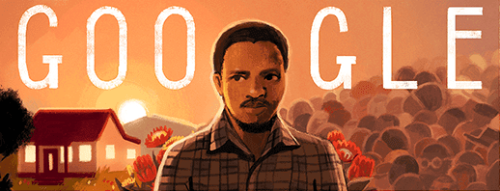
OMG I love the doodle!
#BlackPride #RepresentationMatters
So surprised google recognized him today
from Tumblr http://ift.tt/2hWR8wC
via IFTTT
lagonegirl:
OMG I love the doodle!
#BlackPride #RepresentationMatters
So surprised google recognized him today
from Tumblr http://ift.tt/2hWR8wC
via IFTTT
homura-bakura:
please if you’re a registered voter in the United States, make this call. You do not have to speak to anyone, you only have to leave a message if you have phone anxiety like me. Here’s a potential script:
Hello, my name is [your name] and I’m a registered voter in the United States. I’m calling to urge that the Electoral College vote be postponed until a full investigation of Russian interference in the election, and the Trump campaign’s potential coordination with Russia is complete.
from Tumblr http://ift.tt/2gPDS7X
via IFTTT

please if you’re a registered voter in the United States, make this call. You do not have to speak to anyone, you only have to leave a message if you have phone anxiety like me. Here’s a potential script:
Hello, my name is [your name] and I’m a registered voter in the United States. I’m calling to urge that the Electoral College vote be postponed until a full investigation of Russian interference in the election, and the Trump campaign’s potential coordination with Russia is complete.
from Tumblr http://ift.tt/2gPDS7X
via IFTTT
from-palestine:
Syrian working as bus driver in Turkey discovers his brother, who has been missing for years, among Aleppo evacuees.
from Tumblr http://ift.tt/2hWSes9
via IFTTT

Syrian working as bus driver in Turkey discovers his brother, who has been missing for years, among Aleppo evacuees.
from Tumblr http://ift.tt/2hWSes9
via IFTTT

